Refrigerants in heat pumps – how they work
The refrigerant is the substance that enables a heat pump to transfer heat from the outdoor air, the ground, or exhaust ventilation air into your home.
Here, you'll learn what a refrigerant is, how it works, and why natural refrigerants such as R290 are becoming increasingly common.
In brief:
- A refrigerant transfers heat. The refrigerant enables heat to be transferred from the outdoor air, the ground or the exhaust air into your house.
- Changes between liquid and gas. By changing between a liquid and a gas, the refrigerant can absorb, transport and release heat.
- The development is moving towards natural refrigerants. New regulations are driving the shift towards refrigerants with a lower environmental impact, such as R290.
What is a refrigerant?
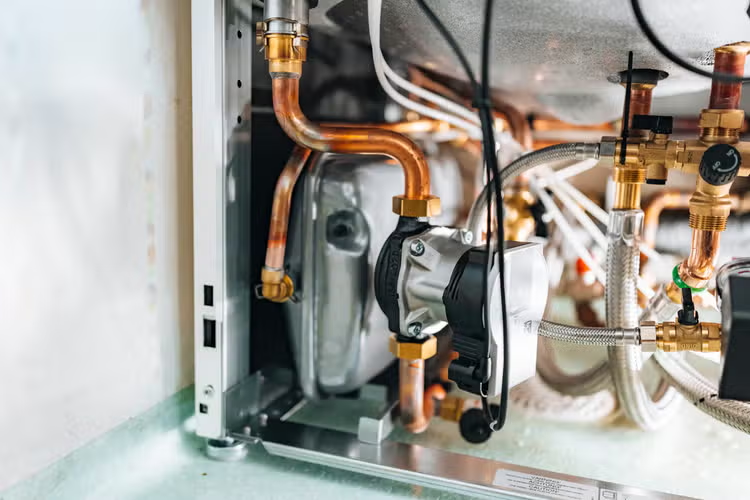
A refrigerant is a substance that enables a heat pump to transfer heat. It circulates within the heat pump’s sealed system and changes between a liquid and a gas. This is what enables the heat pump to capture energy from the outdoor air, the ground or the exhaust air and use it to heat your home.
The refrigerant does not create heat. Instead, it acts as a carrier, transferring energy from one place to another in a continuous cycle.
The refrigerant cycle
The refrigerant operates in a sealed cycle and passes through four stages:
Step 1: The refrigerant absorbs energy. In the evaporator, the refrigerant absorbs energy from the outdoor air, the ground or the house’s ventilation air. Because it boils at a very low temperature, it turns into a gas even when it is cold outside.
Step 2: The temperature increases. The refrigerant then enters the compressor, where both pressure and temperature increase, so that the energy can be used to heat the home.
Step 3: The energy is transferred to the house. In the condenser, the heat is transferred to the house’s heating system or indoor air. At the same time, the refrigerant changes back into a liquid.
Step 4: The process starts again. In the expansion valve, the pressure is reduced, cooling the refrigerant so that it can absorb new energy. The cycle then repeats.
How refrigerants can transfer heat
- When a substance changes from a liquid to a gas, it requires a considerable amount of energy. A simple way to understand this is to think of boiling water. Water heats up relatively quickly to almost 100 °C, but much more energy is needed for it to start boiling and turn into steam.
- The same principle is used in a heat pump. As the refrigerant evaporates, it absorbs large amounts of energy from its surroundings. When it then condenses back into a liquid, that energy is released to the house's heating system.
- Through this process, the heat pump can harness energy from its surroundings and deliver several times more heat energy than the electricity used to power the compressor.

Why the refrigerant matters
There are different types of refrigerants, and their properties influence factors such as energy efficiency, operating temperatures, and environmental impact. The choice of refrigerant therefore plays an important role in both the heat pump’s performance and its long-term sustainability.
Natural and synthetic refrigerants
Refrigerants are generally divided into two categories: natural and synthetic. Natural refrigerants consist of substances that occur naturally in our surroundings, while synthetic refrigerants are chemically produced.
Refrigerants have different GWP values (Global Warming Potential), which are used to measure their potential impact on the climate. Many natural refrigerants have a very low GWP, which is one reason why interest in them is growing. One example is R290, which is used in several NIBE heat pumps.
Changing requirements for refrigerants
The EU F-gas Regulation is gradually restricting the use of certain synthetic refrigerants, known as F-gases, with a high climate impact. Requirements are being tightened step by step and vary depending on the type and capacity of the heat pump. The aim is to reduce greenhouse gas emissions and support the transition to refrigerants with lower GWP values.
R290 refrigerant
- R290, also known as propane, is a natural refrigerant with a very low environmental impact that NIBE has used in its heat pumps for more than 20 years. R290 offers excellent properties for heat pump operation and can contribute to both high energy efficiency and high flow temperatures. It also has a very low GWP value, making it a common choice in modern heat pumps designed to meet both today's and future environmental requirements.
Did you know?
A refrigerant can boil even when the outdoor temperature is below zero. By changing the pressure in the system, the heat pump can control when the refrigerant evaporates and condenses, making it possible to absorb and release heat.