How to choose the right water heater
In brief:
-
Base your choice on your household's hot water demand. The size of the water heater should match the amount of hot water your household uses.
-
Check your water quality. Find out your water's pH level, alkalinity, hardness and chloride content. If you have a private well, a water analysis is recommended.
-
Choose the right corrosion protection. Copper, stainless steel and enamel-lined tanks are suitable for different water qualities.
-
Consider where the water heater will be used. A holiday home often has different hot water requirements than a permanent residence.

How a water heater works
A water heater is an insulated tank that heats and stores hot water for taps, showers and baths. Water is heated either by an integrated electric immersion heater or by an external heat source, such as a heat pump.
Cold water enters the lower part of the tank, where it is heated. As the water warms up, it rises and is stored in the upper section of the tank, where it is drawn off when a hot water tap is opened. As hot water is used, the tank is refilled with cold water, which is then heated in turn.
Choose the size based on your hot water needs
When choosing the size of your hot water cylinder, you should consider how much hot water your household uses during periods of peak consumption. The number of people in the household and how hot water is used determine which size is suitable. A cylinder that is too small may run out of hot water, while one that is too large heats and stores more water than necessary.
To estimate your needs, you can consider how much hot water different activities require.
- A five-minute shower uses approximately 40 to 50 litres of hot water.
- A standard bath requires around 150 litres.
- Washing dishes by hand uses approximately 15 litres.
In a holiday house, a smaller hot water cylinder of 5–55 liters may be sufficient. A household with average hot water consumption may manage with approximately 170–180 liters. With high hot water consumption, the requirement may instead be 200–300 liters.
Smart features can reduce energy consumption
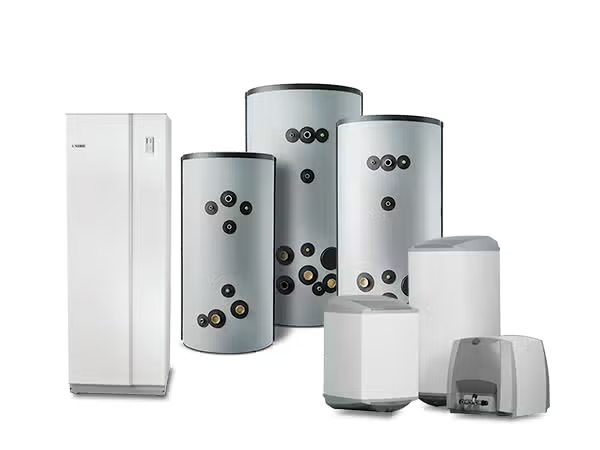
Many of our heat pumps and water heaters in the Compact Smart Control range feature Smart Control. This function learns your household's hot water usage patterns and adjusts heating according to demand.
The result can be lower energy consumption while ensuring hot water is available when it is typically needed.
Step-by-step instructions are available in the user manual for each product.
Choose corrosion protection based on the water quality
The material used on the inside of the hot water cylinder has a major impact on its service life and protection against corrosion, meaning the gradual deterioration of the metal. The interior may be made of copper, stainless steel or enamel. These materials have different properties and are suited to different types of water. The material should therefore be selected based on the water quality in the house.
The most suitable type of corrosion protection depends on several factors and needs to be assessed based on the properties of the water and the conditions of the house. If you are unsure, consult your installer.
Copper – suitable for many water qualities
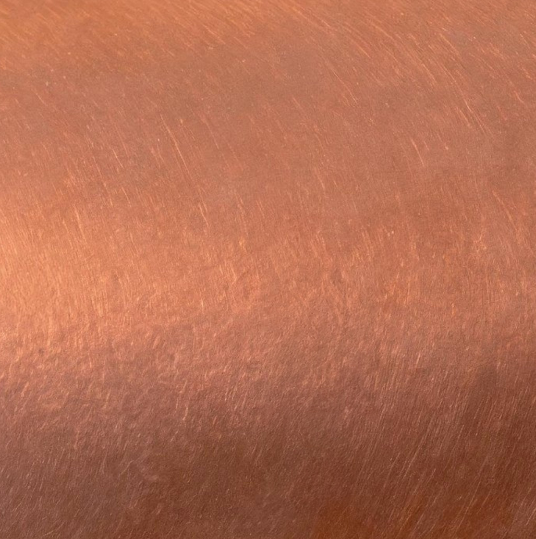
Copper is a common material in hot water cylinders and is generally suitable for balanced water quality.

Stainless steel – suitable for soft and acidic water
A stainless steel hot water cylinder is often a good choice for soft, acidic water with a low pH value. Stainless steel provides good corrosion protection but is more sensitive to high chloride levels.

Enamel – suitable for hard water with a high chloride content
An enamelled hot water cylinder can be suitable for hard, mineral-rich water and water with a high chloride content. The enamelled interior protects the steel tank against corrosion and is supplemented by an anode that provides additional protection. The anode needs to be checked and, depending on the type, replaced when necessary.
Choose a hot water cylinder based on your heating system
Once you have chosen the size and type of corrosion protection, you also need to consider how the hot water will be heated. A hot water cylinder can heat the water using an integrated immersion heater or be connected to an external heat source, such as a heat pump.
COMPACT and EMINENT are electric water heaters with an integrated immersion heater. They heat the water themselves and cannot be connected directly to a heat pump. NIBE VPB and VPA, on the other hand, are designed to be connected to an external heat source and cannot heat the water independently. This type is known as a heat pump cylinder.
The most suitable water heater depends on how your house is heated and how the hot water is to be produced.
If you are unsure which product is suitable for your heating system, your installer can help you choose the right solution.
Water heaters for different heating systems
- Direct electric heating and air-to-air heat pumps. An electric water heater with an integrated immersion heater is suitable when hot water is heated using electricity.
- Ground source heating. A separate water heater can be connected to certain ground source heat pumps, such as NIBE S1156 and F1145, which have a hot water connection. In this case, the ground source heat pump heats the hot water.
- Air-to-water heating. In houses, hot water is usually heated in the heat pump’s indoor unit. The system can also be supplemented with a separate electric hot water cylinder for a larger hot water supply.
- Exhaust air heating. Exhaust air heat pumps usually have an integrated hot water cylinder. The hot water is then heated by the heat pump, often with an immersion heater providing additional support. Some solutions can also be combined with a separate hot water cylinder.
Accumulator tanks and buffer vessels
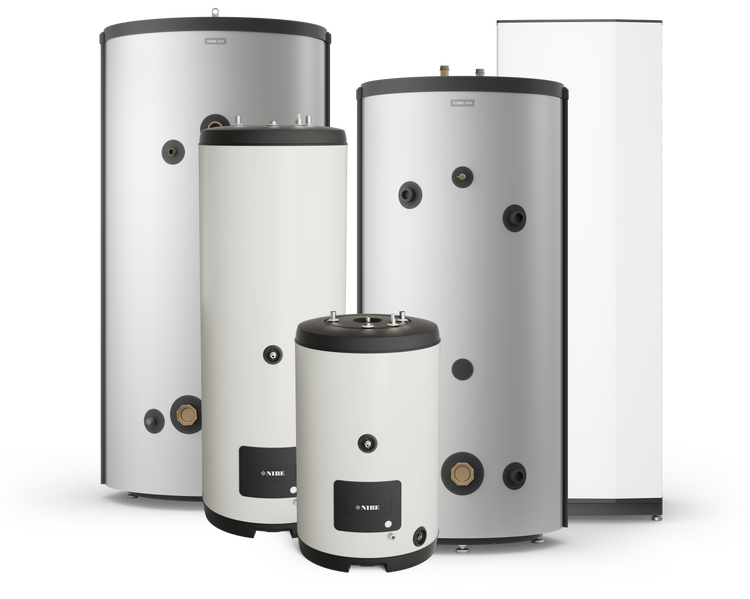
In some homes, accumulator tanks and buffer vessels are used to store energy or create more stable operation within the heating system. Unlike a water heater, they do not normally contain hot water for showers, taps and similar applications.
Accumulator tank
An accumulator tank stores heat energy for later use. In heating systems with an existing accumulator tank, a priority auxiliary heat source may be an option. In this case, the existing tank becomes part of the heating system.
NIBE accumulator tanks are not connected to wood-fuelled heating systems or other external heat sources.
Buffer vessel
A buffer vessel increases the water volume within the heating system and can contribute to smoother operation with fewer starts and stops. It is commonly used with heat pumps when a larger system water volume is required.
Your installer can help determine which solution is most appropriate for your property.
NIBE water heaters and models
We offer water heaters for a wide range of households and requirements. The models are available in different sizes and with different corrosion protection options to suit various conditions.
All NIBE water heaters come with a 3-year warranty.