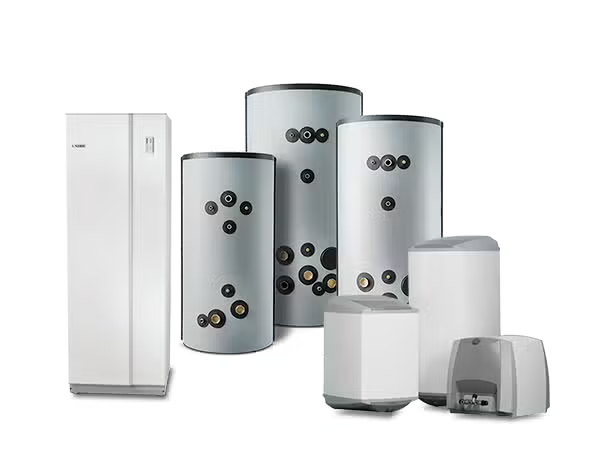
Cleaning and maintaining your water heater
In brief:
- Regular maintenance. Check the hot water cylinder regularly. If you have an enamelled cylinder, the anode should be checked every year and replaced when necessary.
- Maintain the correct temperature. Do not lower the temperature in the hot water cylinder too much. The temperature should normally be kept at around 50°C to reduce the risk of Legionella bacteria.
- Drain when necessary. If your holiday house is to be left unheated over the winter, the cylinder should be completely drained to prevent frost damage.
- Clean when necessary. Flush loose limescale and dirt from the bottom of the cylinder and keep the area around it clean.

What a water heater looks like on the inside
A water heater is a well-insulated tank that heats and stores domestic hot water. Inside is a tank protected against corrosion with either copper or enamel lining. The unit also contains a heating element or a connection to an external heat source, such as a heat pump.
The material used in the cylinder affects how it needs to be maintained:
- Enamelled cylinders have a sacrificial anode that protects the tank against corrosion. The anode breaks down over time and therefore needs to be checked regularly and replaced when necessary.
- Copper cylinders and stainless steel cylinders do not have an anode.
In areas with hard water, limescale and mineral deposits can gradually build up on the heating element and at the bottom of the tank, much like in a kettle. This can make heating less efficient and increase heating times.
Checking and replacing the sacrificial anode
Enamelled hot water cylinders can have different types of anodes that protect the tank against corrosion, meaning that the metal gradually rusts and deteriorates. These may be a sacrificial anode or an electronic titanium anode.
A sacrificial anode is a rod made of magnesium, aluminium or zinc that breaks down over time. It therefore needs to be checked regularly and replaced when necessary. An electronic anode is not consumed in the same way. Check the product manual to find out which type of anode your cylinder has.
NIBE’s direct-current anodes consist of a titanium rod and do not normally need to be replaced.
Follow the link below to see how to check and replace the sacrificial anode in your hot water cylinder.
Check the sacrificial anode step by step
- Step 1: Switch off the power. Always begin by switching off the power to the cylinder.
- Step 2: Turn off the water. Shut off the incoming cold water supply to the cylinder.
- Step 3: Release the pressure. Open a hot water tap in the house and then carefully open the safety valve on the cylinder to release the pressure.
- Step 4: Remove the anode. Unscrew the anode using a suitable socket wrench. Depending on the model, the anode is usually located at the top or bottom of the cylinder.
- Step 5: Inspect the anode. Remove the rod. If the anode is severely worn and its diameter is less than approximately 10 mm at its thickest point, it is time to replace it.
- Step 6: Reinstall the anode. Reinstall or replace the anode. Close the valves, turn on the water and fill the cylinder before switching the power back on.
Empty your hot water cylinder step by step
- Step 1: Switch off the power. Completely disconnect the power to the cylinder.
- Step 2: Turn off the cold water. Shut off the incoming cold water supply to the cylinder.
- Step 3: Open the hot water taps. Open one or more hot water taps in the house so that air can enter the system and the water can flow out.
- Step 4: Drain the water. Open the safety valve or drain valve on the cylinder. On some models, you can connect a hose and direct the water to a floor drain.
- Step 5: Let the water drain out. Wait until the cylinder is completely empty.
- When restarting the cylinder, always make sure that it is completely full of water before switching on the power. Otherwise, the heating element may be damaged. Fill the cylinder and leave a hot water tap open until the water flows evenly and without air before switching on the power.
How to empty your hot water cylinder
A common reason for draining a hot water cylinder is that it is located in a holiday house that will be left unheated over the winter. If water remains in the cylinder, it may freeze and cause damage.
Always check the instructions for your specific model before you begin.
Follow the link below to see how to drain your hot water cylinder.
How to clean your hot water cylinder
Cleaning the water heater can help ensure efficient operation and extend its service life. The cleaning mainly involves flushing out loose limescale and dirt that have collected at the bottom of the tank.
How often a hot water cylinder needs to be cleaned depends, among other things, on the water quality and how much hot water the household uses. In areas with hard water, limescale may build up more quickly than in areas with soft water.
Before starting, it is important to switch off the power and drain the water from the cylinder.
Clean the hot water cylinder step by step
- Step 1: Drain the cylinder. Follow the steps in the section above to drain the water from the cylinder.
- Step 2: Open the cylinder. Once the cylinder is empty, open the inspection hatch if your model has one, or remove the heating element at the bottom. If you are unsure, ask your installer for help.
- Step 3: Clean the inside. Rinse the inside using a water hose. Larger flakes of limescale can be removed by hand.
- Step 4: Avoid sharp tools. Do not use sharp metal tools, as they can damage the enamel or copper surface. Instead, use a soft cloth or sponge if you need to wipe the inside clean.
- Step 5: Reassemble and fill the cylinder. Reinstall all components and fill the cylinder with water. Make sure it is completely full before switching the power back on.
Contact your installer for connection and service
You can often carry out simple maintenance yourself, such as draining the hot water cylinder before winter or flushing out limescale and dirt. However, you should contact an installer for installation, servicing or faults.
Connecting the water heater
When installing a new hot water cylinder, electrical and plumbing work must be carried out correctly. Fixed electrical installations must be performed by a registered electrical installation company. Contact your installer for help with installing and connecting the hot water cylinder.
Service
Contact your installer or an authorised service agent if:
- You suspect a leak
- The safety valve drips excessively or continuously
- The hot water runs out significantly faster than usual
- You need help with cleaning or other maintainance that requires part of the water heater to be dismantled.