Cleaning and maintaining your heat pump
In brief:
- Clean the air filters regularly. Clean filters help the heat pump work efficiently and keep energy use down.
- Keep the outdoor unit clear of leaves, snow and ice. Unrestricted airflow is essential for the heat pump to work properly.
- Check the pressure and bleed the system when needed. This helps the heating system provide even heat throughout your home.
- Look out for alarms and unusual noises. Recurring alarms or changes in operation may indicate that something needs attention.
Why regular maintenance matters
A heat pump with clean filters and unrestricted airflow can work efficiently and keep energy use down. If the filters become clogged or the outdoor unit is covered with leaves, snow or ice, the heat pump has to work harder to provide the same amount of heat. This increases energy use and puts unnecessary strain on the system.
Maintenance needs vary between heat pump types. For exhaust air heat pumps, cleaning the air filter is one of the most important maintenance tasks. Air-to-water and air-to-air heat pumps also need to be kept clear of leaves, snow and ice around the outdoor unit. Ground source heat pumps generally need little maintenance, but it is still a good idea to check the pressure in the heating system and look out for any alarms or unusual changes.
Clean the air filters in your exhaust air heat pump
The air filters are the part of the heat pump that most often needs cleaning. In an exhaust air heat pump, air from your home passes through the filters, where dust and other particles collect. If the filters become clogged, airflow is reduced, energy use increases and the heat pump may trigger an alarm.
Our instructional video shows you step by step how to clean the air filters in an exhaust air heat pump.
How to clean the air filters
- Step 1: Open the heat pump according to the instructions for your model.
- Step 2: Remove the air filters.
- Step 3: Shake or vacuum off the dust.
- Step 4: Put the filters back and close the cover.
How often to clean the air filters
There is no fixed schedule for cleaning the filters. How often they need cleaning depends on how much dust and how many particles are in your home. If you have pets or live in an area with a lot of dust, pollen or air pollution, you may need to clean them more often.
A good habit is to check the filters regularly and clean them when they become dirty, rather than waiting for the heat pump to trigger an alarm.
Keep the outdoor unit clear of leaves, snow and ice
If you have an air-to-water or air-to-air heat pump, part of the system is located outdoors. For it to work efficiently, air needs to circulate freely. Keep the outdoor unit clear of leaves, branches, snow and ice. In winter, it is especially important to prevent snow from building up around or on top of the unit.
How to care for the outdoor unit
- Regularly check that the air inlets and outlet are clear.
- Remove leaves, branches and other debris that may have collected around the outdoor unit.
- Clear away loose snow so that air can circulate freely.
- Make sure there is enough clear space around the heat pump.
If ice forms on the outdoor unit
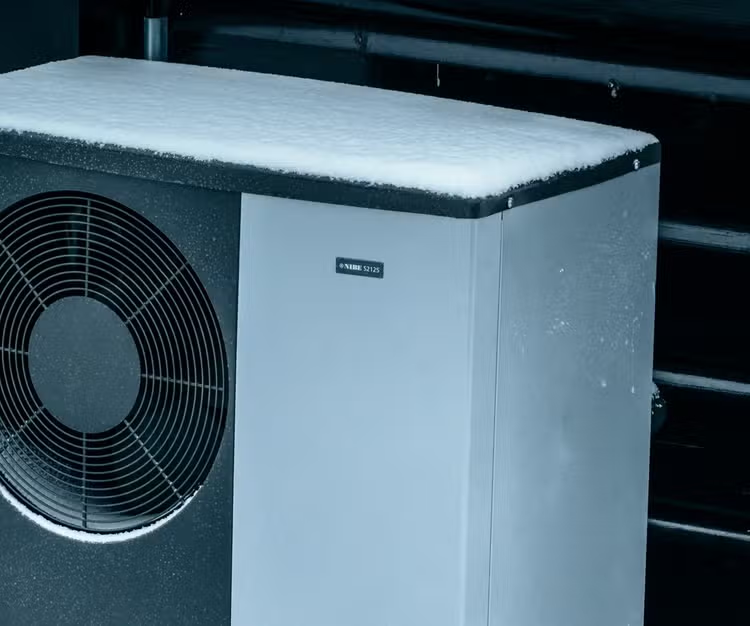
In cold, damp weather, frost can form on the outdoor unit. The heat pump then defrosts automatically at regular intervals. This is part of its normal operation and does not mean there is a fault.
If ice forms, never chip or pry it off. The fins—the thin metal strips on the outdoor unit—can easily be damaged. Instead, let the heat pump’s automatic defrosting cycle do its job, and clear away loose snow around the unit when needed.
If the outdoor unit frequently becomes covered in ice, or the ice does not disappear after defrosting, this may indicate that something needs attention. Contact an installer or an authorised service agent.
Vent the system and check the pressure
If you have a water-based heating system, air can build up in it. You may then need to vent or bleed the system to release the trapped air. Most heating systems are bled manually, although some have automatic air vents.
It is also a good idea to check the pressure regularly. Air in the system or pressure that is too low can lead to uneven heating and affect how well the heating system works.
Our instructional video shows you step by step how to bleed your heat pump.
Signs that your heating system needs venting
Your heating system may need bleeding if:
- Your radiators are unevenly warm.
- You hear gurgling or bubbling noises.
- The pressure in the heating system is lower than recommended.
If the pressure often drops, or air keeps building up despite repeated bleeding, this may indicate that something needs attention. Contact an installer or an authorised service agent.

When to call an installer
NIBE does not require annual servicing, and you can carry out most routine maintenance yourself. If the heat pump is working as it should, regular cleaning and checks are often enough. If needed, an installer or an authorised service agent can inspect the system.
Contact an installer or an authorised service agent if:
- The heat pump triggers alarms repeatedly.
- The heating is not working as it should, or you do not have enough hot water.
- An unusual amount of ice forms and does not disappear after defrosting.
- You suspect that something is not working properly.